
If you’ve ever sat through a lecture wondering how you’ll remember any of it later, you’re not alone. Many UK students spend hours re-reading slides or messy notes — yet still struggle to recall key ideas when exams come around.
So how do you take notes effectively? The answer lies in using structured, science-backed systems that make your brain work with you, not against you.
Two of the best note-taking techniques are the Cornell Note-Taking Method and the Zettelkasten System — and when used together, they can completely transform how you learn.
Let’s explore what they are, how they work, and how to combine them into a practical, modern study system that helps you retain, connect, and actually understand what you learn.
✍️ Why Effective Note-Taking Matters at University
Effective note-taking isn’t just about writing things down — it’s about thinking actively while you learn. Educational research has shown that students who use structured note-taking systems often outperform peers who transcribe passively.
At university, this matters more than ever. Whether you’re revising for exams, writing essays, or planning your dissertation, your notes become your academic memory. Learning how to take notes effectively helps you:
- Understand lectures instead of transcribing them word-for-word
- Retain key theories and concepts long term
- Save time when revising or writing essays
- Build confidence in class discussions and coursework
Now, let’s look at two of the most powerful techniques to take notes effectively
🗒️ The Cornell Note-Taking Method: Structure That Simplifies
Developed at Cornell University in the 1940s by Walter Pauk, the Cornell Note-Taking Method remains a gold standard in academic study techniques (Cornell Notes system overview, Wikipedia).
How It Works
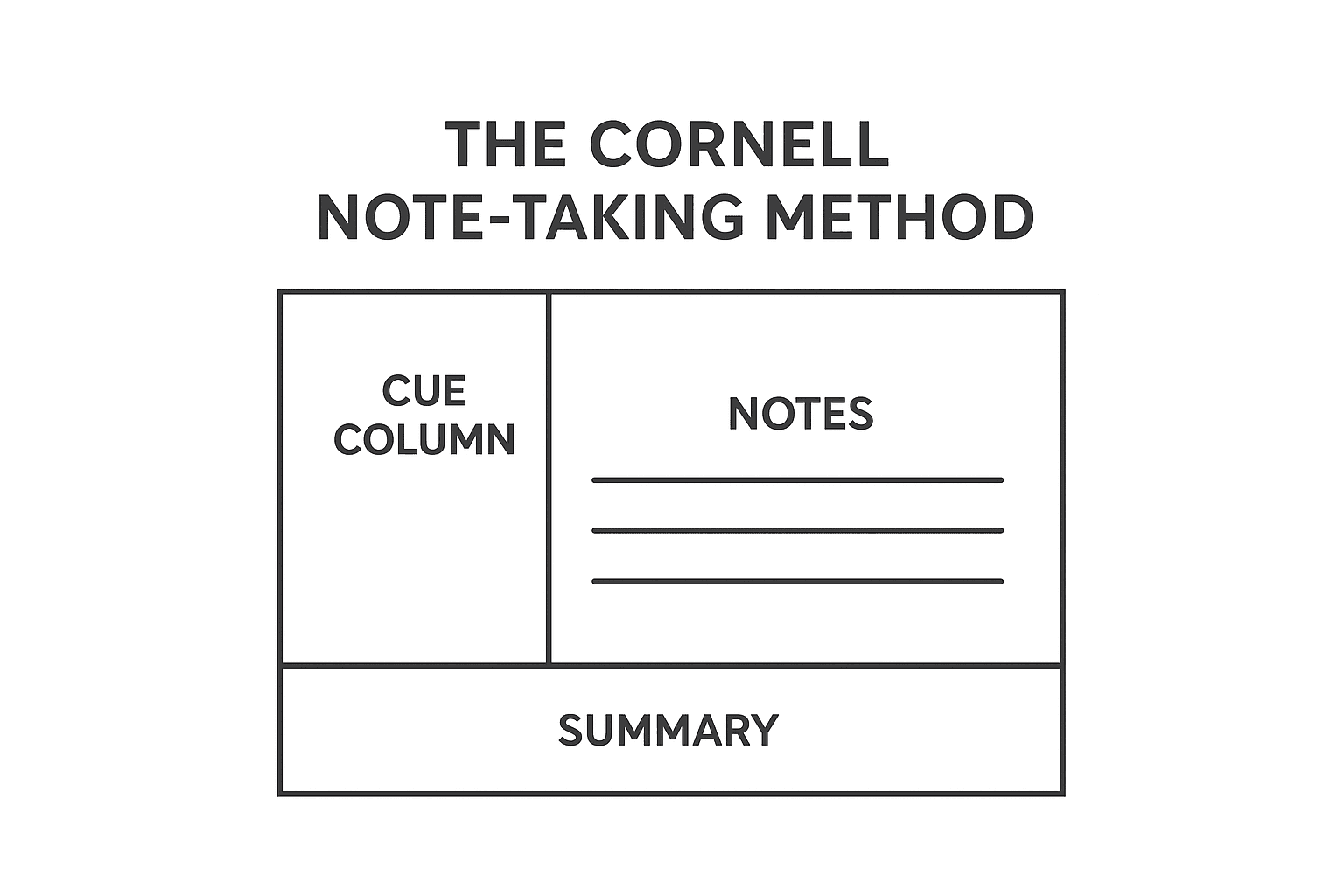
Divide your page into three sections:
- Cue Column (Left): Write keywords, questions, or main ideas
- Notes Column (Right): Jot down detailed notes during lectures or readings
- Summary (Bottom): After class, write a 2–3 sentence summary in your own words
Why It Works
This layout encourages active learning — you’re not just copying but processing and summarising information. It also makes revision faster, as your notes are already structured (University of Maine on Cornell method).
Best for: Lecture-based courses, exam revision, quick review
Pro tip: Use tools like OneNote or Notion to create digital Cornell templates that auto-adjust for any subject
🧩 The Zettelkasten Method: Connecting Ideas, Not Just Collecting Notes
“Zettelkasten” — German for “slip box” — is a knowledge system popularised by sociologist Niklas Luhmann, who used it to produce a vast body of work through interconnected notes (Zettelkasten system overview, Wikipedia).
How It Works
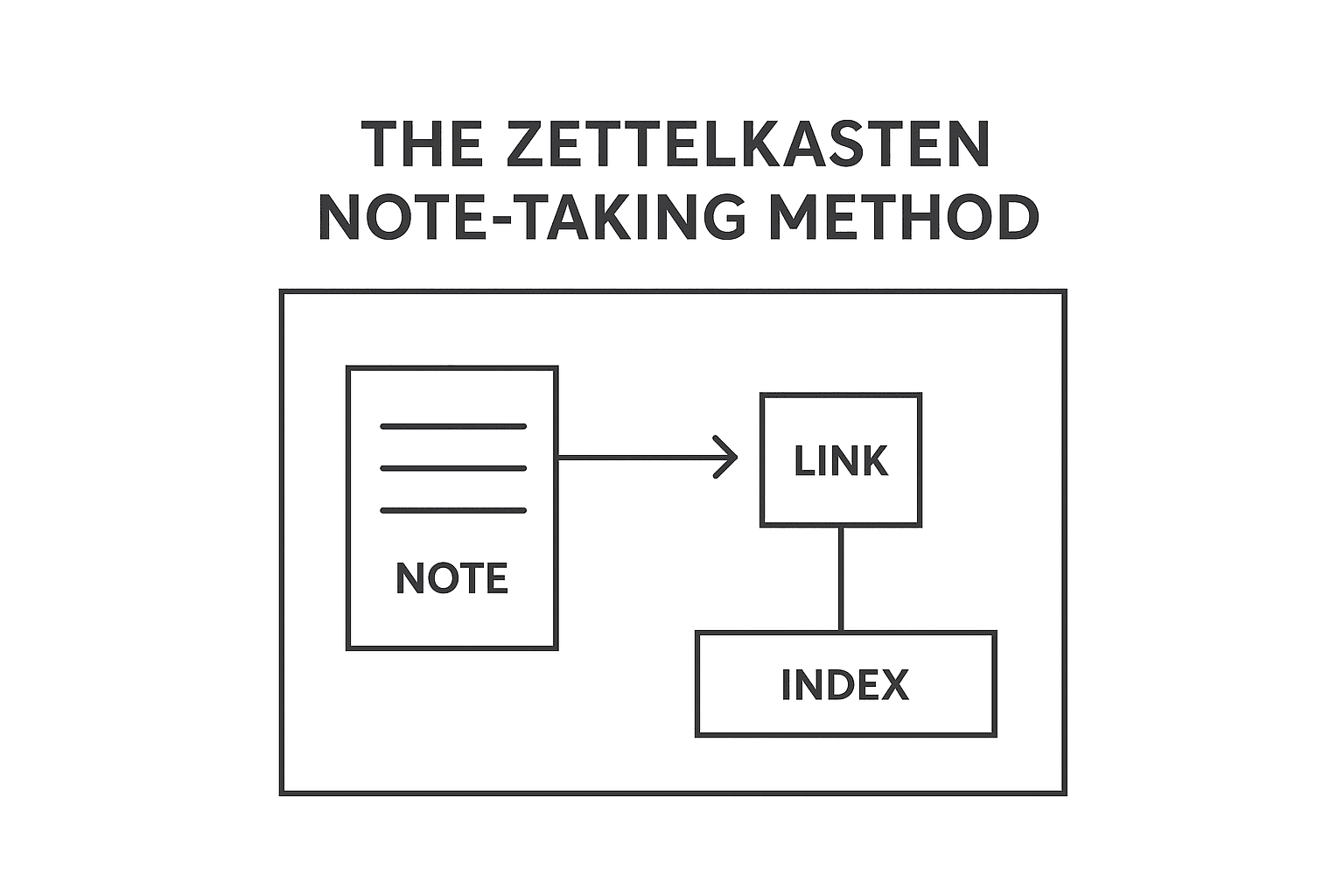
- Each note (“zettel”) captures one idea only, in your own words
- Notes are linked via tags or unique IDs
- Over time, you build a network of ideas, perfect for essays or research
Why It Works
Zettelkasten mirrors the brain’s natural associative structure, helping you see relationships between ideas and deepen understanding.
Best for: Essay writing, dissertations, long-term learning
Pro tip: Use Obsidian, Roam Research, or Logseq for linking notes and navigating ideas
🎓 Bonus Tip: Discover The Power of Audiobooks for Smarter Studying!
🎧 Bonus Tip: It’s worth checking the latest Audible introductory offers — they’re often available as a free trial or for less than £1!
Whether you’re studying, building new skills, or working on personal growth, audiobooks and podcasts make learning more accessible and engaging.
👉 Check the current Audible offers here.
Our recommended pick: How to Take Smart Notes — a brilliant choice for anyone looking to study smarter, not harder.
🎧 Audible – The Ultimate Study Hack!
- 📚 Listen to Textbooks & Study Guides anytime, anywhere.
- 🧠 Boost Focus with expert knowledge and productivity podcasts.
- 🎧 Relax & Unwind with bestselling audiobooks after classes.
- 🔥 Explore New Audiobooks Every Month with your membership!
⚖️ Cornell vs Zettelkasten: A Quick Comparison
| 🧭 Feature | 🗒️ Cornell Method | 🧠 Zettelkasten Method |
|---|---|---|
| 🎯 Purpose | Structure & recall | Idea connection & creativity |
| 📚 Best For | Lectures, reviews, exams | Essays, research, insight |
| 🕒 When to Use | During or right after class | When processing and linking ideas |
| 💡 Learning Style | Linear & summarised | Non-linear & associative |
| ⚙️ Ease of Use | Easy to start | Takes time to build network |
| 📈 Outcome | Clear, reviewable notes | A growing thought system |
Both methods are powerful — Cornell gives clarity, while Zettelkasten gives depth. Together, they form a fuller system of capture → connect → create that will lead to effective note-taking.
🔗 How to Combine Cornell + Zettelkasten for Maximum Learning
- Step 1 – Capture with Cornell: Use Cornell during lectures to record main ideas
- Step 2 – Review & Reflect: After class, identify 2–4 key ideas worthy of deeper exploration
- Step 3 – Create Zettels: Turn each highlighted idea into a Zettelkasten note and link it to related notes
- Step 4 – Review & Expand: Revisit and connect notes weekly — build new relationships among ideas
💬 Think of Cornell as your “capture tool” and Zettelkasten as your “thinking engine.” This combined system helps you learn deeply and think creatively.
💻 Practical Tips & Tools for Smart Note-Taking
Let’s explore some app and habit tips to elevate your note-taking:
- Digital Cornell Templates: Use OneNote or Notion templates to speed layout creation
- Zettelkasten Software: Obsidian, Logseq, or Roam Research help with linking and searching
- Colour Codes & Tags: Use consistent colours/tags to distinguish themes and ideas
- Weekly Review: Revisit Cornell summaries and Zettels to reinforce learning
- Write in Your Own Words: Understanding deepens when you explain ideas personally
🎯 Final Thoughts: Mastering the Art of Taking Notes Effectively
Learning how to take notes effectively is more than a skill — it’s a mindset. When you pair the Cornell system’s clarity with the Zettelkasten’s depth, you’re no longer a passive note taker — you become an active thinker.
So try it. Mix, match, tweak. Let your notes become your launchpad for insight, not just memory.
Suggested: Looking for more study guides on our blog? Check below:
- How To Revise For Exams Effectively & Retain Information
- How to Write an Essay at University Level & Get High Grades
🎓 University Essentials – Everything You Need for Uni
Did you know? We’ve put together tailored student essential lists to help you through every aspect of university life!
- 📝 Student essentials: Everything you’ll need to stay prepared, productive, and comfortable during a typical Uni day.
- 💡 Accommodation essentials: Make your space feel like home (and don’t forget the stuff everyone forgets!).
- 🖥️ Study from home essentials: Tools and tips to create a distraction-free, efficient study setup.
- 🥘 Kitchen essentials: From budget-friendly basics to smart cooking tools that make life easier.
- 🎧 Coolest gadgets for university: Level up your uni experience with tech and tools students actually use.

❓ FAQs: How to Take Notes Effectively
Use Cornell to structure core content, then combine it with Zettelkasten notes for idea mapping.
They serve different roles — Cornell captures, Zettelkasten connects. When combined, they’re more powerful.
Cornell: OneNote or Notion; Zettelkasten: Obsidian or Logseq.
Use Zettelkasten links to form arguments and find cross-topic connections — your personal idea map.
Yes — many use Cornell notebooks, then transfer ideas into card-based Zettelkasten systems or digital later.
Even 10–20 minutes after class is enough. Quality beats quantity.
Cornell aids immediate recall; Zettelkasten supports long-term memory by connection and retrieval.
Absolutely. The best note systems enhance active thinking — not passive copying (Note-taking methods, Wikipedia).
It was created by Walter Pauk in the 1940s and popularised in his book How to Study in College.
Niklas Luhmann developed it in the mid-20th century, eventually building a network of 90,000 index cards linked by concept (Zettelkasten, Wikipedia).
💸 Bonus Tip: Free Amazon Prime
Did you know? If you are 18-24 years old or a student in the UK, you might be eligible for 6 months free of Amazon Prime, including next-day delivery, Prime Video, Music, and exclusive student discounts!
It’s a great perk that can genuinely save you time and money!
👉 Check your eligibility here.
🎓 Amazon Prime Student: The Ultimate Uni Perk!
- 🚚 Free Next-Day Delivery
- 🎬 Amazon Prime Video
- 🎶 Prime Music
- 🎓 Student-Exclusive Offers